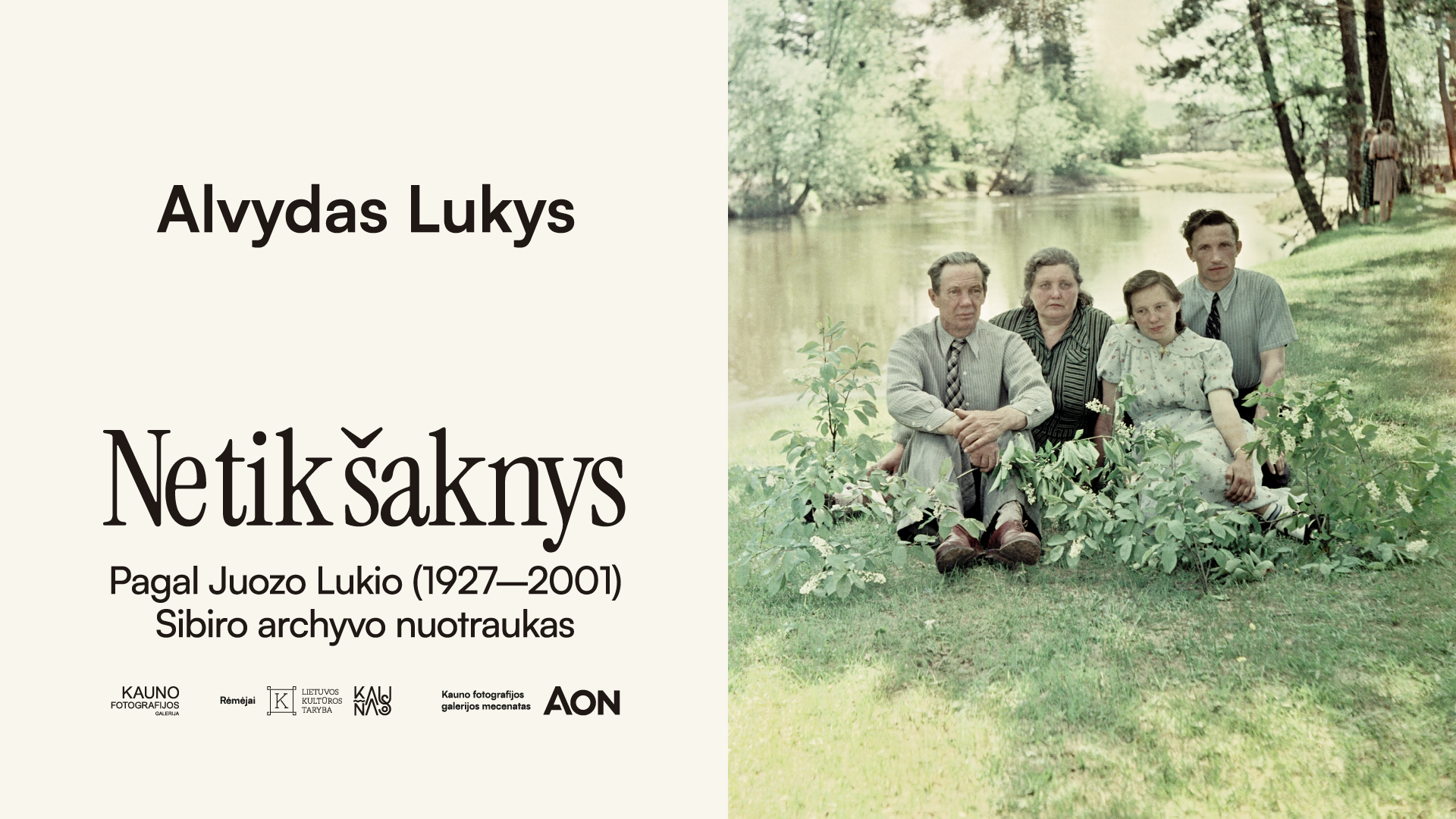
From 30 January at Kaunas Gallery (Vilnius g. 2) the exhibition “Not only roots. Based on photographs from the Siberian archive of Juozas Lukys (1927-2001)” is open. The exhibition will be open until 2 March.
According to the author, the exhibition is a remediation of the photographic legacy of his father Juozas Lukys. The photographs were taken in exile in the Irkutsk region, Alsamay, and several years after his return to Lithuania. The photographer selected, scanned, technically arranged and printed the inherited negatives in various sizes.
A. Lukys says: “In May 1948, Jonas and Agota Lukiai and their son Juozas, who had been deported from their own farm in Buvainiai village, Joniškis county, as well as Kazimieras and Stanislava Petrauskas and their children Aldona and Algimantas from Sauginiai village, Šiauliai county, were in one barrack. After working hard, they eventually had their own farm again. Aldona and Juozas started a family. By a miracle, Juozas’ sister Eugenia, who was not deported, sent her brother a camera after Stalin’s death. The most remarkable thing I noticed in my father’s photographs, and what inspired this idea, was human dignity and the need for beauty, despite a life of semi-starvation, bereavement, humiliation, physical and psychological abuse. My parents returned to Lithuania in September 1958 and I was born in early November.
My father’s family photo albums were my first photography school. From him I learnt how to make developers (in his words, “fix the medicine”), how to print, and gained valuable knowledge about the technical side and quality of the analogue photographic process. What prompted me to create this pictorial narrative was the word “picture”, which I often heard in my childhood, and the agricultural relationship I saw in the photographs with nature. The vegetation and landscapes of nature are the main backdrop of the photographs, and at the same time, it is like an attempt to cover a poor household with a white gauze.
Some time ago, I suddenly became interested in plants and their cultivation myself. The aesthetics based on plant observation has been a project for more than a decade. I photograph them in their natural environment at different times of the year, using a folding camera at a minimum distance. This specific method results in an ornament-like and abstract aesthetic. The colour medium format film and the blurred optics of the first half of the last century further emphasise the importance of plastic form. The choice of camera was not only based on aesthetic considerations. My father had used a similar technique in Siberia, the Moskva -5, a Soviet copy of the German Zeiss Ikon. He also took colour photographs. The exhibition features one such shot, which was the idea behind the whole project. My photographs in this exhibition are like the realisation of my father’s aesthetic dream. I think he would agree with that. Despite all the trials of life, beauty and aesthetics were things he took for granted and apparently helped him to remain optimistic. I notice this again and again when I look at his photographs and negatives.”
The project and the exhibition are supported by the Lithuanian Council for Culture and Kaunas City Municipality. Patron of Kaunas Gallery – AON.