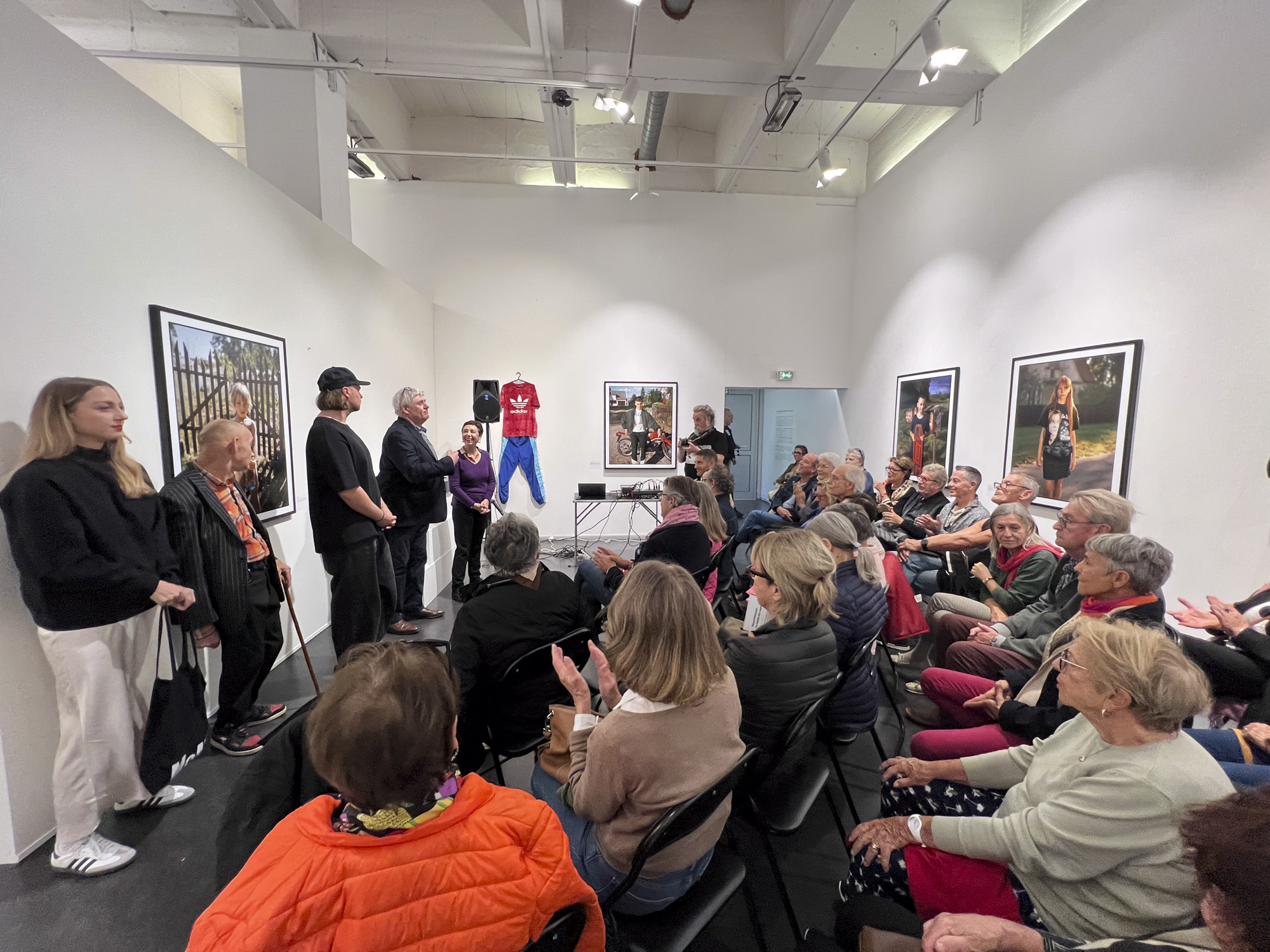
Contemporary Art Centre Captures, in collaboration with Kaunas Photography Gallery, presented the exhibition “Nonobstant la fuite du temps – Contemporary Lithuanian Photography”, which is part of the programme of the Lithuanian season in France.
A conference and a meeting with the artists took place on 12 October. Curators Jean Marc Lacabe and Gintaras Česonis presented the context of Lithuanian photography at the conference. The exhibition has a temporary library of Lithuanian photography publications.
The exhibition offers a dialogue between two generations of Lithuanian photographers, who use a unique visual language to explore themes of memory, change and everyday life. It reflects the evolution of Lithuanian photography, which has its roots in the Lithuanian School of Photography of the 1960s and 1970s, famous for its humanistic approach to documenting the country’s cultural changes. Pioneers of this movement, such as Antanas Sutkus, Romualdas Rakauskas and Aleksandra Macijauskas, laid the foundations for new generations of photographers.
The exhibition features works by Rimaldas Vikšraitis, whose intricate compositions capture intimate moments of remote rural life. His provocative yet subtle images link the legacy of 1960s Lithuanian photography with contemporary artists including Ieva Austinskaitė, Ieva Baltaduonytė and Donatas Stankevičius.
I. Austinskaitė’s colour photographs explore the peripheries of the city, highlighting abandoned industrial buildings and contemporary residential houses, offering a new perspective on the local landscape. Baltaduonytė’s current project UPROOTED (2022-) combines portraits and landscapes to tell the story of war-torn Ukrainian women and the difficulties they faced in seeking refuge in Lithuania. Meanwhile, D. Stankevičius, in his series Legendary Past, explores the very nature of the photographic medium, recreating childhood memories and inviting the viewer to reflect on personal and collective history.
These photographers, each in their own way, transcend visual boundaries, preserving and redefining Lithuania’s cultural identity through their work. This exhibition invites the public to discover Lithuania’s social history and transformations through the prism of contemporary photography.
Kaunas between the wars and Royan after the war underwent a similar transformation, when both cities were forced to redefine their identities through architectural and urban design solutions. Kaunas, as a temporary capital, moved from a provincial historical past to the pursuit of modernity, while Royan, after the reconstruction of its war ruins, embarked on a new, modernist vision of urban renewal. These transformations reflect both historical memory and the need for progress, which has led cities to adapt to new socio-political and cultural contexts. Despite their different historical contexts, both cities have managed to create a recognisable and distinctive identity.
The exhibition at the Royan contemporary art space runs from 12 September to 17 November.
Photographs by Gintaras Cesonis.